1、 SDF22 Six Dimensional Force Sensor Product Introduction
Product brand: ZXSCELL, Zhongkesel, USA
Product Series: SDF22
Product type:Six dimensional force sensor
Product Features:
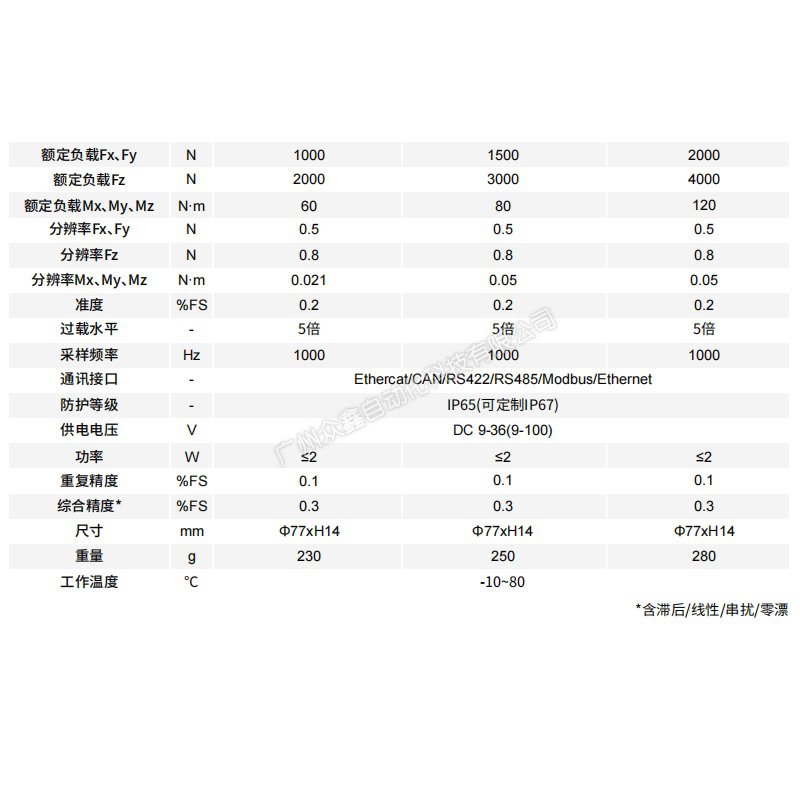
(1) Industrial grade sensor IP67 waterproof and dustproof
(2) 5 times overload capacity
(3) Built in low-noise amplifier
(4) High precision 0.3% FS
(5) Customization, usability, compatibility, and fast deployment
2、 SDF22 Six Dimensional Force Sensor Product Parameters
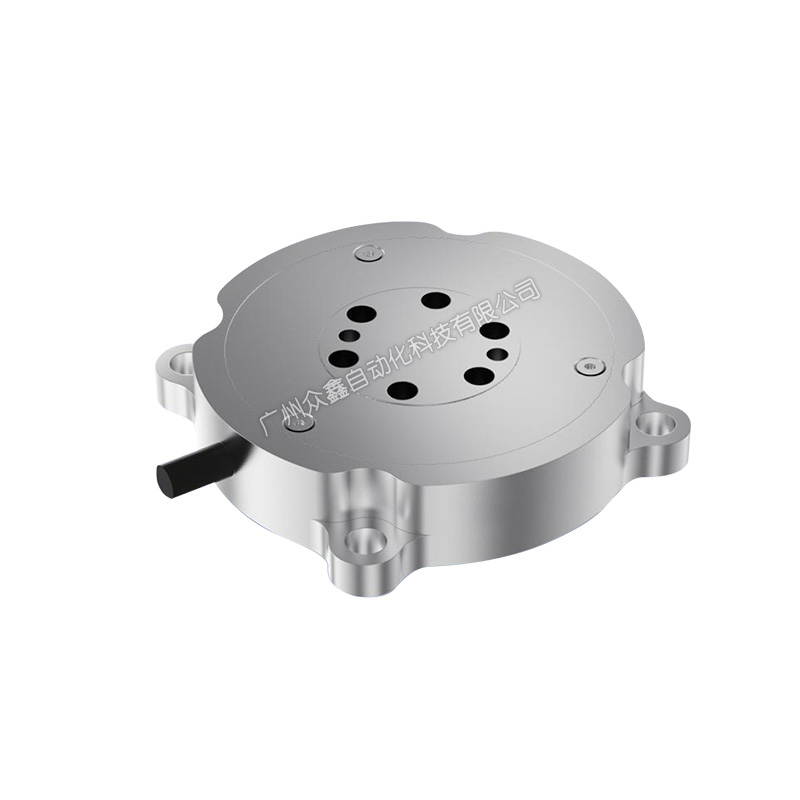
3、 SDF22 Six Dimensional Force Sensor Product Image
4、 Expand Reading
The six axis force sensor is one of the most core force sensing components in the fields of robotics, precision manufacturing, and testing. It can simultaneously measure forces in three orthogonal directions (Fx, Fy, Fz) and moments around these three axes (Mx, My, Mz) in three-dimensional space, and is therefore also known as a six axis force/torque sensor.
The six dimensional force sensor is one of the most core components in the field of force perception. It can simultaneously measure the forces in three mutually perpendicular directions and the moments around these three axes in three-dimensional space at the same reference point, that is, the complete six mechanical components. Its basic structure cannot be separated from a carefully designed elastic body, commonly including cross beam shape, spoke shape, cylindrical shape, etc. When external force is applied to this elastic body, extremely small deformations occur, and the strain gauges or embedded piezoelectric crystals attached to it will convert this deformation into electrical signals.
Due to the fact that elastic bodies are inherently integrated structures, any direction of force will cause composite deformation of the entire elastic body. Therefore, the original signals output from each bridge are naturally coupled, and forces in one direction will produce false outputs in other directions, which is known as inter dimensional crosstalk. To obtain the true and accurate six force components, decoupling is necessary. After the sensor is manufactured, the manufacturer will place it on a high-precision calibration bench, add standard weights to each dimension in sequence, record the output of all channels, and establish a six by six calibration matrix. In practical use, using this matrix to calculate the original signal can restore the true strength and torque. Sensors with better performance will also be equipped with temperature compensation and nonlinear correction, and some even introduce artificial intelligence compensation models to further suppress the effects of temperature drift and creep.

Sales contact information:
Miss Chen:
sales@zhongxintmt.com
18520271262
Mr. Huang:
huanghao@zhongxintmt.com
18688492451




 Sales Engineer - Miss Chen